

Podcast Then & Now #41: Teresa Cherfas in conversation with Ksenia Luchenko
About this episode
8 May 2026
by Teresa Cherfas
Welcome to the 41st edition of the Russian-language podcast Then & Now with me, Teresa Cherfas.
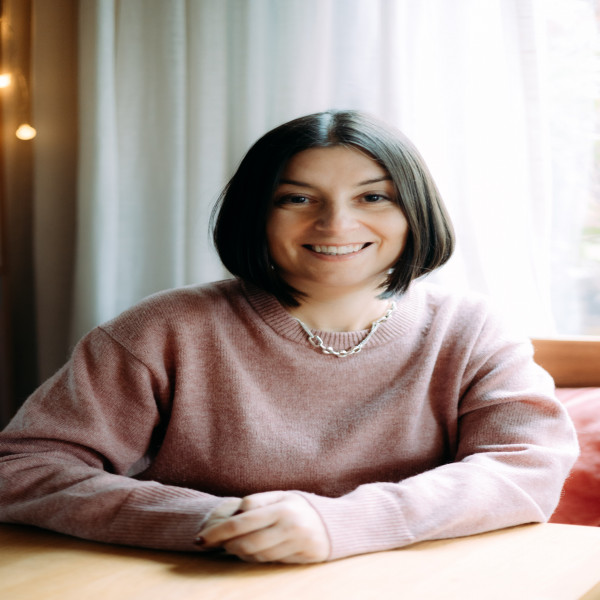
Ksenia Luchenko (pictured above) is the author of the book Благими Намерениями – Русская Церковь и Власть от Горбачева до Путина [‘With Good Intentions: The Russian Church and State from Gorbachev to Putin’] for which she received the ‘Prosvetitel’ award (Enlightener Prize) in 2025. That same year, her name was added to the list of ‘foreign agents’ and, in March this year, she was sentenced in absentia in the Russian Federation to eight years’ imprisonment under the ‘military fakes’ law. Ksenia left Russia in April 2022. Prior to this, she had worked extensively as a journalist and scholar in the field of church affairs and media.
This podcast was recorded on 7 May 2026
Questions:- What prompted you to leave Russia so soon after the full-scale invasion of Ukraine?
- Your book With Good Intentions was published last year. Why did you choose that title?
- In 2014, the annexation of Crimea took place, and shortly afterwards, the so-called separatist war in the Donbas region of Ukraine began. Did this mark a turning-point in relations between the Orthodox Church and Putin’s Kremlin, a turn that led to the ‘road to hell’?
- In the summer of 2021, Putin wrote a lengthy treatise on his interpretation of Russian history and the place of the ‘Russian world’ in contemporary politics.. Could you comment on the role of the Russian Orthodox Church in shaping his worldview?
- The Russian Orthodox Church is currently one of the main ideologues of the war with Ukraine, calling the war a holy war and glorifying death on the battlefield. In this context, what is a ‘holy war’ and what are the criteria for defining it?
- And what about relations between the Russian Orthodox Church and the Ukrainian Orthodox Church?
- An important event during Gorbachev’s policies of glasnost and perestroika was the celebration of the millennium of the Russian Orthodox Church in 1988. In hindsight, does it seem surprising that it was celebrated so widely in a country that was still atheist – the USSR?
- Patriarch Aleksy, who led the Russian Orthodox Church during that period, was succeeded by Kirill, who became patriarch in 2009. How did their characters differ? What role did this play in the Church’s subsequent relations with the state?
- It is said that the only institutions that did not undergo reform following the collapse of the Soviet Union were the Russian Orthodox Church and the KGB. Is this true?
- Following the collapse of the Soviet Union, did the Russian people welcome the revival of the Russian Orthodox Church? And to what extent has the revival of the Orthodox Church been related to the development of Russian nationalism?
- For several years now, under Putin’s leadership, Russia seems to want to be seen as a bastion of so-called “traditional values.” These values have been enshrined in laws criminalising homosexuality and declaring the ‘dissemination of LGBT propaganda’ a criminal offence. What is the role of the Russian Orthodox Church in this legislation? How is its role in this sphere evolving today in connection with the war in Ukraine?
- Today, Putin’s “holy war” against Ukraine seems to have been a precursor to the ‘holy wars’ of other global leaders – this is how Israel’s wars in Gaza and Lebanon are justified, this is how President Trump presents his war against Iran, and this is the case with the jihads of the Ayatollah and Hamas. Does this surprise you in the 21st century?
- Pope Leo XIV sharply criticised President Trump for his bombing of the civilian population in Iran, citing the Bible and God’s commandments. How did the Russian Orthodox Church react?– And Putin?
- Are there dissidents among Russian Orthodox priests? And if so, what is the situation with them?
Podcast Then & Now #41: Teresa Cherfas in conversation with Ksenia Luchenko
